RV-10 Wing Stall Series
Completed 4/14/2008Sometimes you just have to go play for your kids benefit. ;) For a while now I've kept some yarn and painters tape in the hangar because I wanted to do some tufting of the RV-10 just for curiousity. Of course, the areas that I'd love to see, aren't visible from my own plane, but it would be fun when flying formation.
My daughter though recently gave me an excuse to have some fun. For her independent study project she chose the subject "How does an airplane fly?", which gave me the opportunity to play. Of course, those who say it's ALL because of the faster speed of the air over the wing causing lower pressure, are dead wrong, as there are also effects from the air hitting the bottom of the up-angled wing that come into play....once described in Flying Magazine by showing how a barn door could fly. Now, try to explain all this to a 6 (almost 7) year old though and see how much they retain. :)
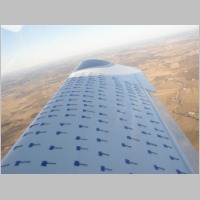
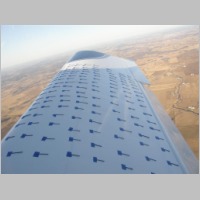
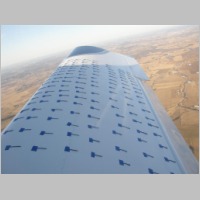
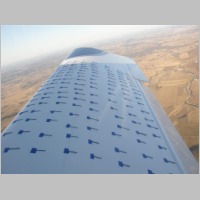
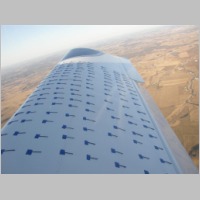
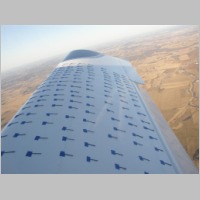
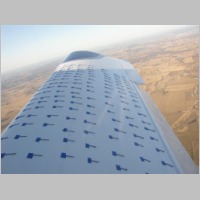
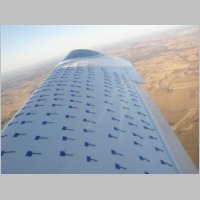
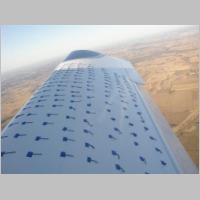
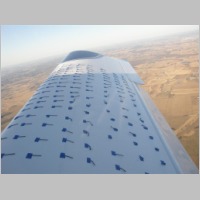
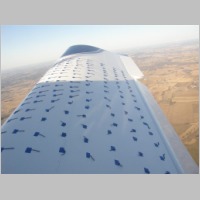
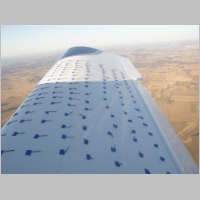
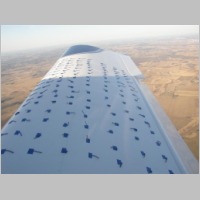
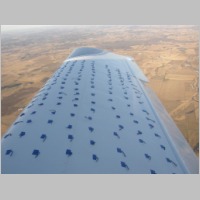
So anyway, we tufted the wing, and set out to show the airflow during a stall series. Let me tell you, full-power-on stalls in the RV-10 are just not something you'll likely spend much time doing. The angle to the sky is just plain ridiculous. For these stalls, I chose 1 *real* notch of flaps, and a fairly low power setting, although not as low as approach power. This gave a good nose up pitch, and a pretty wild ride. The RV-10 just does not enjoy being beaten into submission in a stall. Sure, you can do a gentle buffet, but I wanted a real stall, so I hauled back on the stick and held it there, and the plane bucked like a broco as I maneuvered the controls to hold it in the sky. Generally I drop off to the right when it finally wants to give up, but in general it takes a lot of work to get anything to drop.
Check out the airflow pattern....it's completely what we've always been told.....smooth airflow, with the stall starting at the root and spreading forward and outward. Neat stuff to see the strings in the 2nd row of tape pointing backwards to the movement of the plane....it's then that you know that the airplane must be dropping pretty well at a mega-high AOA.
Not much else to say, but enjoy the pics!
 |
 |
 |
 |
 |
 |
 |
 |
 |
 |
 |
 |
 |
 |