Oxygen
Filling
First of all, I'd highly recommend reading the
article "Getting High on Welders Oxygen" available on AvWeb at
http://www.avweb.com/news/columns/182079-1.html
For my background: I owned a SCUBA store for many years,
filling thousands of cylinders over those years. Sure, SCUBA
uses air, but.... I was one of the earlier adopters
of Trimix gas mixing in SCUBA diving. We used Argon in our
drysuits for insulation, and we breathed anything from 100% Oxygen
for decompression, to mixtures of Helium + Oxygen + Air (O
2
+ N
2) to do extremely deep "Technical" dives. I
spent a great deal of time filling cylinders for all of these
gasses as well, and owned more than 2 dozen large sized cylinders,
some used for Oxygen, Air, and Helium. Filling Oxygen isn't 100%
risk free, but neither is filling air, or even hauling your Oxygen
bottle. Done safely, there are no issues that you can't
overcome and you shouldn't be very uncomfortable with the filling
practice. The biggest thing with Oxygen is using Oxygen
compatible materials, and ensuring they're Oxygen clean. This
means no rubber o-rings, and no silicone or petroleum greases,
only Viton or O
2 compatible o-rings, and Halocarbon
greases. Also, the biggest issue you can cause beyond
non-clean and compatible components is being careless in how you
open and close your valves. Always open the valves slowly
and allow the lines to pressurize slowly. When any gas,
including air, is suddenly compressed, it can cause "adiabatic
compression" that will heat the air greatly, and instantly.
I've felt this myself, and used to demonstrate it to people
by turning on air cylinders and feeling the output of a 1/4" O.D.
pigtail line made of stainless steel. The instant you
sharply turn the flow on, you get a sudden hot rise in temperature
of the air coming out, and the tubing around it. It only
lasts a microsecond it seems. The problem is, if there is
hydrocarbon contamination in the system, that heat can cause
spontaneous ignition of the hydrocarbon. The solution is to
use non-hydrocarbon lubes, and compatible and clean materials, and
then you will have nothing that can burn. It can also ignite any
particles that flow fast and hit a sintered filter in a system, so
preventing particles racing thru the system at hundreds of miles
per hour will help prevent any issues you may have. Once you
have a spark you can have a fire, and even steel will burn if it
starts, as the fire will be fed by all the oxygen it needs.
I've seen an oxygen fire from adiabatic compression first hand, so
I know how fast and how bad it can get...but for your normal
transfilling situation, this should be very easy to avoid.
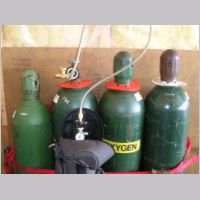
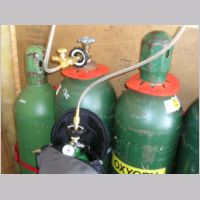
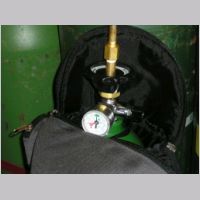
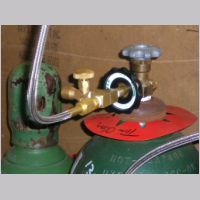
Below are some photos of my personal filling system. I
happened to own 4 cylinders. Of the ones in the photos
below, I own them all, and they are the larger 300cu.ft. bottles,
the smaller one came from a very angry situation where I sent my
bottles out for hydrostatic retest, and despite me labeling my
bottles, they "lost" one, and had to give me one of theirs.
Makes me very angry but nothing I can do now. Hydro retests
are done every 5 years. These cylinders can be leased from
most any gas supplier, on a long-term lease, which is very
affordable. If you had 2 or 3 bottles (2 works fine, 3 is
much better, 4 is overkill for most people), you will likely get
years worth of fills depending on how often you use your Oxygen
system. If you are filling oxygen bottles for 2 or 3 pilots,
and have a 3 or 4 bottle system, and you use Oxygen regularly, you
can almost definitely save money filling yourself. In my
situation, where I already own the cylinders, it's a no
brainer. Aviation Oxygen fills are $35-75 when I travel, and
they're not available on my home field, and that's for just tiny
cylinder full. In comparison, I think the Oxygen fill for
one of these 300cu.ft. bottles is about the same price...or maybe
a couple bucks more, and it can fill many small bottles. I
also have to pay the $20-30 retest fee per bottle every 5 years,
so there is that minor cost. If you lease, you usually won't
pay that cost, just the price of the lease, which is usually a 5
year lease. I will price out the transfiller hose at the
bottom of the page.
To fill an O
2 cylinder, you would then use a "cascade"
method. Filling from the first cylinder to provide the bulk
of the Oxygen, then moving to the 2nd to bring the pressure
higher, and then the 3rd to bring it to the top. After cylinder
#1, each other cylinder provides progressively less oxygen, but
retains it's higher supply pressure, allowing you to fill your
bottle close to capacity. Having 2 source bottles will get
you pretty full for a low cost, but you will likely not be able to
fill your cylinder to full capacity more than a few times.
Adding a 3rd bottle will exponentially give you full fills for
many more fills. Adding a 4th and that number goes way up
again. You don't swap out the first bottle until it gives
you maybe less than 1000psi of fill of your cylinder....you can
even go longer, down to maybe 500psi, before you swap it out,
especially if you have 4 bottles. Once you get that first
bottle not filling a bulk of your fill, you just remove it and
rotate your bottles down a number, have that one filled, and put
that in the #4 position (or 3 in a 3 bottle system). For my
uses right now, I have 4 bottles, but really only need to
maintain a 3 cylinder Cascade system to get the fills that I
want. But since I own them, I'll keep draining cylinder #1
and #2, and #3, and then when cylinder #4 is not able to
completely fill the portable cylinder, I will probably remove
bottles #1 and #2 and have them re-tested and filled, then shift
them down and make them #3 and #4. For my uses, that will
probably give me 3 or 4 years worth of Oyxgen at least at that
point....maybe even 5-10 years. The cascade method maximizes
your use as good as possible without an oxygen booster.
A Booster pump runs on regular compressor air, and pumps the air
in the storage cylinder up in pressure to use it down to about
300psi, but still get 2200psi output for filling your portable.
It's the most economical way to go if you did tons of fills
and happen to have an expensive oxygen booster pump on hand, but
would be impractical for most anyone but an FBO. For more
info on boosters, go here:
http://www.hiipumps.com
and check out model 3G-SS-20-O. The booster pumps also add a
layer of complexity, danger, and maintenance. The oxygen
fire I had seen previously was in an Oxygen booster system.
Connecting and filling the cylinder is also easy. I
installed handwheel nuts on my fill whip, so you just run them
down snug. The nipples have a flexible tip to help it seal
easily. Then, you make sure the bleed valve is closed, and
you open the valve on the portable cylinder. Now you'll be
able to read the pressure in the portable. Without a gauge
on the large cylinder, you will have to keep track of what
pressure you left it at after the last fill. If you have
more pressure in the portable, it can backfill into the large
cylinder. This can be prevented by using an inline
checkvalve, if you wish. If the storage pressure is higher
than the portable, then fill away...just open both valves slowly
and let the pressure equalize over a couple minutes. The
portable bottle will get hot, if you don't go slow enough.
This probably it's much of a problem, but as the bottle
cools, the pressure will drop and you will not end up with a full
fill. In the SCUBA world, they fill cylinders in a bath of water,
just to prevent them from heating up too much. When the pressure
has equalized, shut both valves, and then open the bleed valve to
remove pressure from the line. You need to do this or you
can't remove the hose easily. If the portable still isn't
filled, then just close the bleed valve again and move on to the
next cylinder and repeat. It's very easy. Make sure
you check your portable bottles stamp so you don't exceed the
rated pressure during filling.